Main menu Close main menu Main menu Menu ×
News

What we mean by “Nature” and the linguistic challenges of Nature Directed

Inspired by Ngũgĩ wa Thiong’o, Lucy Rose Sollitt and Domenica Landin unpack FutureEverything’s use of the word Nature as Means of Communication and a Carrier of Culture

Co-authored by FutureEverything Creative Director Lucy Rose Sollitt and Domenica Landin.


Image: How Forests Think: Toward an Anthropology Beyond the Human (2013) by Eduardo Kohn

Lucy Rose Sollitt, Creative Director of FutureEverything, and Research Fellow, Domenica Landin, explore the linguistic challenges and complexity of bringing Nature onto our Board. Together, they introduce how we arrived at our relational interpretation of the word “nature” and share the methods we’ve devised to help ensure our language aligns with our values and intentions. 

The environmental movement is fraught with contested language. Take the word ”nature”, a term that’s at the heart of our initiative to bring Nature onto the Board. Nature is a seemingly benign word, but peel back a few layers and it’s loaded with colonial histories and binary associations that underpin eco-social injustices. Yet in the UK context (and in an overwhelming media landscape), the term Nature is accessible, direct and easy to grasp. Using an imagined alternative risks losing attention and impact; it can alienate people.

With Nature Directed we’ve set ourselves a challenge to address ecological crisis on a structural level, this means embracing the complexities and trying to navigate them with care. A first step is to be clear about how we are using and interpreting language, and to commit to gradually reimagining it.


Language as a carrier of meaning

Lakoff and Johnson (1980) offered a strong counter-argument to the notion of disembodied language—that it emerges from and is shaped by the lived experiences of beings with bodies. . And not just one kind of body, but billions of different bodies, each with their own sensorimotor histories and relational contexts (Di Paolo, Cuffari and De Jaegher, 2018).

For humans, language reflects this embodied knowing. Abstract concepts—such as feeling ‘down’ or ‘uplifted’—are often understood through metaphors rooted in our spatial experience of being in the world, revealing how our bodies—and, by extension, our environments—shape the ways we make sense of and relate to the world.

But things become more complex when the metaphors we use extend beyond the conventional conceptual system of everyday language. A metaphor like “love is trust” implies that we must understand what trust is in order to understand love—we explain one concept through the lens of another (Lakoff and Johnson, 1980). Or take “Mother Earth”, a term that evokes life-giving and nurturing qualities often associated with a maternal figure—one that frames the planet not as an object to be exploited, but as a relational being, even when that maternal figure is capable of violence in the right circumstances (Plumwood, 2003).

The idea that language shapes meaning is not new—it has been honoured and practiced across diverse cultural traditions for generations. In the Japanese religion and tradition of Shinto, the concept of kotodama (言霊)—often translated as the “soul” or “spirit” of language—refers to the belief that words possess intrinsic power. Similarly, in Hindu and Buddhist traditions, sounds and utterances—such as the repetition of mantras—are believed to influence not only the environment but also the body, mind and spirit, revealing language as a generative force that actively alters consciousness and shapes reality. This also points to the notion that language is inherently sonic, engaging multiple senses beyond the cognitive.

The role of language in shaping ecological relations

Some of the most pressing issues wrapped in the term nature are definitions of what is and isn’t deemed to be human (and by whom) (Celermajer et al., 2021), and the perception of humans as somehow separate from a singular entity called nature, a resource we can manage and control, or “save”. Most Indigenous knowledge systems have no word for nature – the term is irrelevant because the binary doesn’t exist in the first place. The term nature carries an ideological weight, along with power to affect how we perceive and respond to ecological challenges. 

This is precisely the concern of ecolinguistics—a field that examines how language influences our perceptions of the environment and our actions within it (Stibbe, 2020).

In 1990, linguist Michael Halliday delivered a keynote address at the 9th World Congress of Applied Linguistics, calling for a reimagining of language in response to the ecological crisis. He argued that “classism, growthism, destruction of species, pollution and the like are not just problems for the biologists and physicists. They are problems for the applied linguistic community as well” (Halliday, cited in Steffensen and Fill, 2014, p. 10).

When new terms are proposed in the context of socio-ecological change, we can see this as the linguistic community—all of us—collectively taking matters into its own hands—recognising that language holds the power to shape both perception and action. Take the widely circulated notion of ‘sustainable development’, which has fallen short of its own ambition to “meet[s] the needs of the present without compromising the ability of future generations to meet their own needs” (WCED, 1987, p. 27).

The term ‘sustainable’ became a self-fulfilling prophecy, sustaining the very capitalist regimes it purported to critique, while ‘development’ continues to invoke metrics of growth rooted in extractivist logics. These metaphors carry ideological weight, shaping not only discourse but also policy, perception and planetary futures. As sustainability reveals its limitations, ‘regeneration’ has emerged as a transformative paradigm shift. Buckton and colleagues observe that “[a]t its most basic semantic level, something regenerative has a capacity to exist or be created again” (Buckton et al., 2023, p. 825). 

This is why new words are often proposed for concepts we think we understand. This is exactly the case with the term ‘nature’. Timothy Morton argues that placing ‘nature’ on a pedestal and admiring it from afar does for the environment what patriarchy does for the figure of woman: it distances, idealises, and ultimately disempowers. 

Given that Nature is a concept and an interpretation, the complexities, why have we still chosen to use this term? And what do we mean by it?

Finding a common language

There are many valid reasons to avoid using the word ‘nature’. Yet this is precisely where we find ourselves in a double bind—caught between critical theories and the “language of real life” (wa Thiong’o, 1994, p. 13), where such terms remain deeply embedded in everyday discourse.

We noticed this after hosting a couple of sessions with Working Group members: new terms, academic terms, niche terms, repurposed terms—terms reimagined because the old ones no longer felt fit for purpose. And yet, were we not all talking about nature? 

We decided to take our lead from Ngũgĩ wa Thiong’o. In Decolonialising the Mind, he writes “Language, any language, has a dual character: it is both a means of communication and a carrier of culture” (1994, p. 13). We found ourselves in a position of having to first find common language and then to reimagine language. That’s how the glossary started. 

We began by identifying the language we were using in our conversations. Even when two words appeared distinct—such as ‘relationships’ and ‘relationality’—they revealed similar depth and qualities, each expressing a mode of existence in relation to something else, shaped through those very connections. The language that emerged was both contextual and intentional.

We began to document this in a shared space (Google Docs), with the intention that it could continue growing and evolving. Around the same time, artist Kaajal Modi recommended we take a look at the CLEAR Lab Book. On doing so we were particularly interested in its glossary of terms and the politics embedded within them (CLEAR, 2021). Their approach resonated with our own acts of reimagining language—particularly as we began to recognise the colonial, political and ideological biases embedded in words we had previously taken for granted, such as ‘stakeholder’. 

Commonly used in institutional settings to involve, communicate with and collaborate alongside individuals or communities who may be affected by ensuing decisions or initiatives (Reed et al., 2024), the term ‘stakeholder’ carries colonial roots. Its usage, particularly as a tokenistic gesture, can “reduc[e] the relationships between people and place to financial or economic transactions that ignore the cultural and spiritual significance of the land and the non-human species to which people are inherently connected” (Reed et al., 2024, p. 2). Words do matter—especially in decolonial efforts. That’s why we chose to share it with you, who are part of the linguistic community.

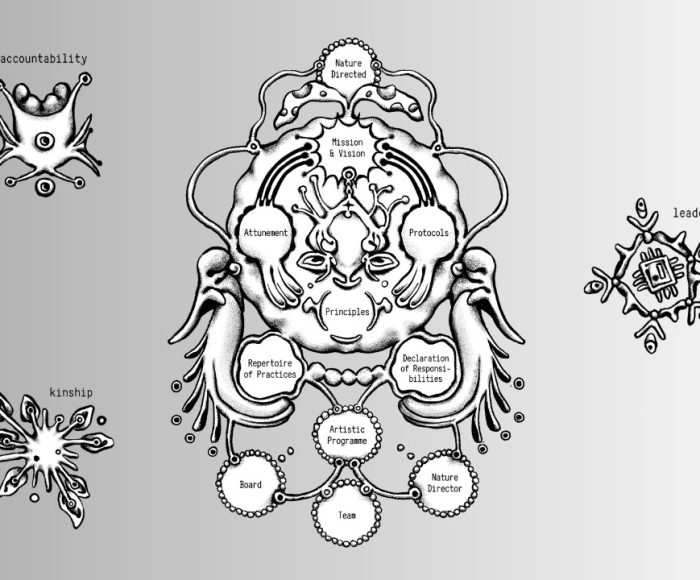
The Nature Directed glossary of terms is a key part of our contribution to broader efforts to reimagine language. It invites us to co-develop vocabulary as part of our coming together. We welcome a plurality of meanings, recognising that words carry different resonances for different people, shaped by context, experiences and perspectives.

Foregrounding relationality bound in bodies and place

With Nature Directed then, we are initially using the term Nature as a common language, and working towards reimagining the terminology through devices such as the glossary. It’s also important to us that our use of the term Nature has practical specificity—that it is informed by relations bound in bodies and place.

As an organisation that focuses on technology and works in distributed ways, initially, it doesn’t make sense for us to define a specific relationship with a natural entity, such as a river. Instead, we see Nature in broad relational terms, as the Web of Life*, and have devised creative workflows which allow us to interpret the definition in a more nuanced and specific way.

Inspired, in part, by the proven success of place-based decision-making in the Rights of Nature movement—for example, in the Whanganui river (2017) and Los Cedros forest (2021) rulings. We’ve devised an initial set of practices which help us to explore how the Web of Life manifests in the relational specificities of our projects. The practices are intended to help us to attune to, acknowledge and figure out how we collaborate with the individuals or groups—both human and more-than-human—convened in any given project. 

How we approach “nature” then depends on the particular combination of people, place, technologies, and their intra-relations, local and global. It’s fluid and hybrid, and defined using the practices we have devised. The practices range from methods for “naming and acknowledging” the entities convened in the project, to “drawing relational boundaries” to provide some broad parameters around the myriad of lifeworlds affected by our actions (somewhat like the “most affected principle” in multispecies justice discourse). Ultimately, these practices are intended to decentralise our perspective and enable us to arrive at some methods for understanding how the project is contributing to the relational health and ecological flourishing of that particular configuration of nature.

Attunement

Finally, attunement underpins the practices and is core to arriving at how we interpret Nature in any given context. It also has a linguistic dimension.

We embrace Di Paolo and colleagues’ assertion that “we are linguistic bodies” (Di Paolo, Cuffari and De Jaegher, 2018, p. 5)—understanding ourselves as beings who do language, whose very being is shaped through communicative acts and relational meaning-making.

This extends beyond human language to include forms of communication with the more-than-human world. From the gestures we make with our fingers when touching and feeling the soil in our hands, to the subtle ways we attune to our surroundings—we are continually engaging in linguistic encounters that go beyond symbolic language.

When Eduardo Kohn (2013) writes about open semiosis, he reminds us that we are open to other forms of sense-making and meaning-making—forms we share with the more-than-human world. These linguistic encounters are embodied, affective and situated, reminding us that communication is not confined to words but unfolds through multisensory, relational attunement. The affective methodologies of art, along with that of spiritual ecology (Mickey, 2020; Sponsel, 2007), are especially well placed to facilitate, interrogate and interpret such encounters.

How, then, do we co-create language that remains open to this linguistic complexity?

We believe that by including diverse perspectives—human and more-than-human—we can begin to explore this question and arrive at meaningful interpretations of common terms, like Nature. In doing so, the goal is to reconnect, decolonise and repair the fractured relationships that the terminology originated from in the first place.

* A widely cited (though sometimes debated) 19th-century quote attributed to Chief Si’ahl (Seattle) of the Duwamish Tribe exemplifies this, stating: “Humankind has not woven the web of life. We are but one thread within it. Whatever we do to the web, we do to ourselves. All things are bound together. All things connect”